
General patient education, not a diagnosis or individualized treatment plan. Your treating clinician’s instructions take priority. Elite Oral Surgery’s Bonney Lake practice opens January 2027.
Proximity is the search term, but it is the wrong criterion. The right oral surgeon for your case depends on the procedure you need, the surgeon’s training, the practice’s clinical scope, and how well it communicates with your referring dentist. Here is what actually matters, and what does not.
The short answer
- Training required for the specialty 4 to 6 years
- The training to look for Hospital-based OMS residency
- Elite, from Tacoma via SR-410 16 minutes
- Surgeons who will see and treat you at Elite One
Oral and maxillofacial surgery requires four to six years of surgical residency after dental school, the longest training pathway in dentistry. Where your surgeon completed that residency is public information any practice can confirm.
The short answer
- Single implant, post and abutment and crown $3K to $6K
- Multiple teeth, two teeth through most of an arch $6K to $30K
- Full arch at Elite, all-inclusive per arch $15,000
- Full arch elsewhere, chains and multi-provider practices $20K to $50K
Ranges reflect Washington State pricing across independent surgeons, multi-provider practices, and chain centers. Your own figure depends on anatomy and case complexity, which is what the consultation establishes in writing.
What oral surgeons actually do
Oral and maxillofacial surgery is a dental specialty requiring four to six years of post-doctoral surgical residency after dental school, the longest training pathway in dentistry.
These practices handle the cases that exceed a general dentist’s surgical scope: complex extractions, dental implants, jaw surgery, oral pathology, facial trauma, and IV sedation or general anesthesia.
Procedures performed at an oral surgery practice
- Wisdom teeth removal, particularly impacted or complex cases
- Surgical extractions of broken teeth, fractured roots, and ankylosed teeth
- Dental implant placement, single, multiple and full arch
- Full-arch dental implants, including All-on-4, All-on-6 and zygomatic protocols
- Bone grafting and sinus lifts, as the foundation for implant placement
- IV sedation and general anesthesia, where conscious sedation is insufficient
Where the line sits with your general dentist
Routine extractions of fully erupted teeth, simple bridges and crowns, and uncomplicated restorations are handled by general dentists. Cases beyond that routine scope, impacted teeth, complex extractions, surgical implant placement, IV sedation and jaw surgery, are referred out. The pattern is well established, and most general dentists have ongoing relationships with one or more oral surgery practices.
In plain language
If you already have a general dentist, start by asking who they refer to and why. Their answer carries more information than any directory listing, because they see the outcomes and the correspondence afterwards.
How to evaluate a practice, beyond proximity
A search for an oral surgeon near you returns a list of nearby practices. The list does not tell you which one is right for your case. Six things do.
- Training and specialty scope. Oral and maxillofacial surgery requires an accredited four to six year hospital-based residency, and not every clinician placing implants has completed one. Ask where your surgeon trained and verify it on the practice website.
- Match between practice scope and your case. Some practices concentrate on full-arch implants, jaw surgery or oral pathology, others carry the full general scope. For a full-arch case you want substantial full-arch volume. For a complex extraction you want strong general scope. Match the practice to the case rather than to the drive time.
- Communication with your referring dentist. Your general dentist usually continues your restorative care after the surgery. Whether the surgical practice shares imaging, operative reports and post-operative recommendations clearly is the difference between coordinated care and being caught between two providers.
- IV sedation capability. In-house IV sedation administered by the surgeon under a Washington General Anesthesia Permit is meaningfully different from oral sedation or a referral to an outside anesthesiologist. More on IV sedation.
- Practice model and continuity. A single-doctor practice means the surgeon you meet at consultation performs your surgery and follows your recovery. Multi-doctor practices and chains may distribute care by schedule. Neither is inherently better, but the difference is real and worth knowing before you choose.
- Pricing transparency. Practices that publish pricing, or give written estimates at consultation, generally have confidence in their structure. Quote-only pricing with add-ons that appear later produces surprises during treatment.
What does not tell you much
Star ratings on their own, before-and-after galleries, and superlative marketing claims. None of them are verifiable in the way documented training, imaging capability and a written quote are.
The longer evaluation framework, including the red flags worth watching for, is on choosing an oral surgeon.
Elite Oral Surgery, in Bonney Lake
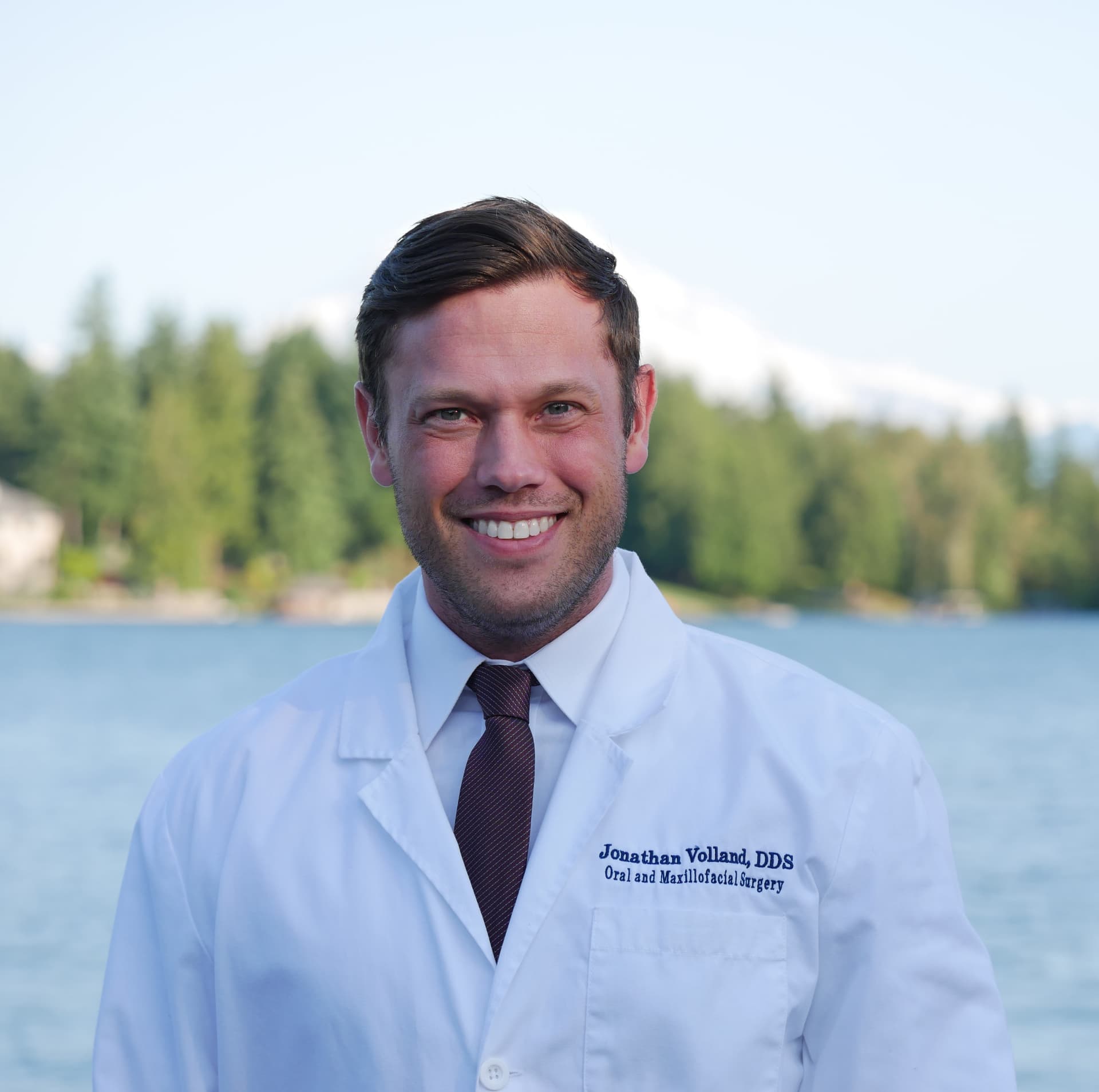
Elite Oral Surgery and Dental Implants is an independent single-doctor practice in Bonney Lake, Washington, opening in 2027. Dr. Jonathan Volland is an oral and maxillofacial surgeon with eight years of Naval surgical practice including residency at Naval Medical Center Portsmouth and attending positions at Madigan Army Medical Center, Naval Hospital Bremerton and NAS Oak Harbor.
Practice scope
Full general oral surgery scope, with full-arch dental implants as the primary specialty. Every procedure listed above is performed in-house, including IV sedation under a Washington General Anesthesia Permit. The practice is built around single-doctor continuity: every patient meets Dr. Volland at consultation, and Dr. Volland performs every procedure personally.
Getting here
Drive time to Bonney Lake
- Tacoma, via SR-410 — 16 minutes
- Federal Way — about 25 minutes
- Seattle — 30 to 45 minutes
- East Pierce County corridor — Sumner, Lake Tapps, Buckley, Enumclaw
City-level pages cover parking, routes and local context for Bonney Lake, Tacoma, Seattle, Federal Way, Puyallup, Auburn, Sumner, Lake Tapps, Buckley, Enumclaw and Edgewood.
The surgeon you meet at consultation is the surgeon who performs your surgery.
— Dr. Jonathan Volland
For referring dentists, the for dentists page covers referral procedures, communication protocols, and the practice’s commitment to honouring referral relationships. We do not market to your patients after their surgical case is complete.
Common questions
Do I need a referral to see an oral surgeon?
Not in Washington. Most patients arrive on a referral from their general dentist, which is useful because it brings your records and imaging with you, but you can schedule directly. If you do come without a referral and you have a general dentist, we will coordinate with them on the restorative side.
How much does distance actually matter?
Less than most patients expect for the surgery itself, and more than they expect for follow-up. A full-arch case involves several appointments over about twelve months, so a drive you would tolerate once may be worth weighing across ten visits. That said, matching the practice to the procedure matters more than saving twenty minutes.
What is the difference between an oral surgeon and a periodontist for implants?
Both place implants. Oral and maxillofacial surgeons complete four to six years of surgical residency covering anesthesia, trauma and the full surgical scope, which is why complex extractions, severe bone loss cases and IV sedation typically sit with them. Periodontists specialise in the gum and bone tissue around teeth, and place implants within that scope. For a straightforward single implant either can be appropriate. For a full arch under sedation, the surgical training is the relevant difference.
Is a single-doctor practice better than a larger group?
It is different rather than better. A single-doctor practice gives continuity, since the same surgeon consults, operates and follows your recovery. A larger group may offer wider availability and cover for absences. For complex cases requiring a sustained relationship, continuity matters more. For routine work, availability may matter more.
How do I verify a surgeon’s training?
Washington licence records are public through the state Department of Health, and any practice should confirm where its surgeon trained without hesitation. Reluctance to do so is itself informative.
When does Elite open?
The practice opens in Bonney Lake in 2027. You can join the opening list now, and we will reach out as soon as consultations are available.