
Wisdom Teeth Removal · Bonney Lake, WA
Wisdom teeth removal, done right.
oral and maxillofacial surgical care for third-molar extractions, in-house IV sedation, same-day surgery, and AAOMS-aligned protocols. Performed by Dr. Jonathan Volland.
At a glance
The procedure, the timeline, and the practical details.
What most patients want to know before they read any further.
Surgery Time
30–90 min
All four, single session
A referral from your general dentist is required. If you don’t have one, our office can recommend a dentist in the Bonney Lake area.
When & why
When wisdom teeth should come out.
The AAOMS recommends wisdom-teeth evaluation in late adolescence, typically ages 16 to 19, when roots are still developing, bone is more elastic, and recovery is fastest.¹
Too little room, by evolution
Modern jaws are simply too small for four third molars. Impacted, partially erupted, or malpositioned teeth are the rule, not the exception.
Asymptomatic isn’t problem-free
Bacteria colonize the tissue around impacted teeth without pain. Cysts, second-molar damage, and decay can progress silently for years.
They rarely improve with time
The AAOMS position: all impacted third molars are potentially pathologic. Teeth flagged as problematic in adolescence seldom get better on their own. Our practice position When impacted wisdom teeth are present, removal of all four in a single session is typically recommended, one anesthesia exposure rather than two, one recovery rather than two, and the reality that teeth tend to be impacted bilaterally for the same anatomical reasons. Exceptions exist: fully erupted, well-positioned teeth with good hygienic access can sometimes be retained. The right approach for your case is determined at consultation with clinical exam and panoramic imaging.
Impaction types
How wisdom teeth get stuck.
Impaction classification informs the surgical approach, the recovery, and the timing. Most third molars fall into one of four patterns.
Common
Mesioangular
~44% of cases
Tilts forward toward the second molar, often pressing against it. Associated with periodontal pocketing, food trapping, and recurrent infection of the overlying tissue.
Surgical removal generally indicated, especially when symptomatic or damaging the second molar.
Common
Vertical
~38% of cases
Oriented like a normal tooth but partly covered by gum or bone. May erupt over time, but more often stays submerged with pericoronitis and hygiene difficulty.
Surveillance or removal, depending on eruption progress, symptoms, and second-molar relationship.
More Complex
Distoangular
~6% · higher risk
Tilts backward toward the rear of the jaw. Difficult surgical access often requires more bone removal, with a higher complication rate in older patients.
Earlier removal often preferred to avoid the raised complication profile of older-patient surgery.
Most Complex
Horizontal
~3% · most demanding
Lies sideways, crown pointing into the second molar’s roots and often deeply buried. Highest risk of adjacent-tooth damage; removal usually requires sectioning.
Removal generally indicated to protect the second molar, ideally before further bone deposition.
Timing
Why removal is easier in the late teens.
Across decades of study, teeth removed in the recommended window have shorter surgery, faster recovery, and meaningfully lower complication rates than the same teeth removed after 25.
Ages 16–19
The recommended window
Roots are still forming and not yet deeply anchored. Bone is elastic and remodels readily. Many patients return to school or work within 3–4 days, the window AAOMS specifically references.
Ages 20–25
Still favorable
Roots are more fully formed but still surgically manageable. Bone density is rising yet amenable to standard technique. Recovery runs 4–7 days for most patients.
Ages 25+
More involved
Roots are fully developed and often calcified into bone. Surgery requires more bone removal and longer time; recovery stretches to 7–14 days, with statistically higher rates of nerve injury and dry socket.
The same removal of the same tooth carries a different risk profile at 18 versus 35, not because the tooth changes, but because the surrounding biology does. This is why AAOMS emphasizes early evaluation rather than waiting for symptoms. Active surveillance remains reasonable for asymptomatic, well-positioned teeth, provided the monitoring actually happens.
Comfort & anesthesia
How comfortable you’ll be.
Three options, matched to case complexity, anxiety, medical history, and your preference. All anesthesia at Elite is administered in-house by an oral surgeon trained in hospital-based anesthesia.
Local Anesthesia
- Numbing only, fully awake
- Best for fully erupted, simple extractions
- Minimal recovery from anesthesia
- No driver required, you can drive home
- No fasting requirement
- Lowest-cost option
IV Sedation
- In-house, by an oral surgeon
- Standard choice for most wisdom-teeth cases
- Relaxed, drowsy, and without memory of the procedure
- Faster surgical workflow
- Sedation recovery: 1–2 hours
General Anesthesia
- Fully unconscious
- Reserved for complex cases or severe anxiety
- Fully unconscious throughout
- Most involved monitoring and recovery
- Anesthesia recovery: 2–4 hours
- Driver and full-day observation required
IV sedation is the standard recommendation for impacted wisdom teeth, the combination of comfort, surgical efficiency, and having no memory of the procedure makes it the right default for most patients. Alternatives are presented honestly at consultation. The recommendation is matched to your case, not applied as a one-size-fits-all mandate.
Recovery
What recovery actually looks like.
Expectations for the days after surgery. Most patients are surprised how manageable it is when the procedure is done by an oral surgeon at the recommended age.
Rest, ice, and gauze.
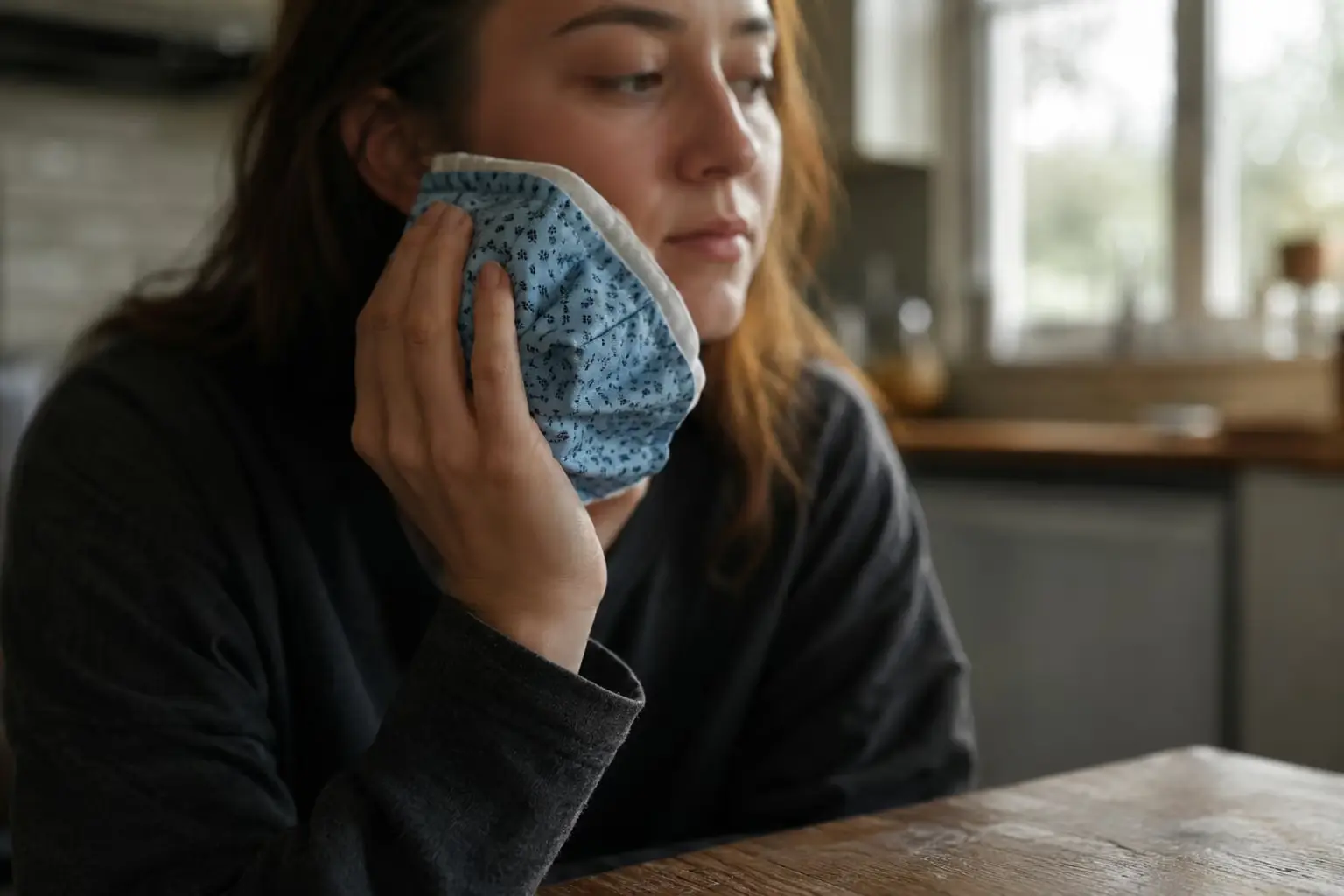
Drowsy for 1–2 hours after IV sedation. Gauze pressure controls bleeding for the first 30–45 minutes. Ice in 20-minute on/off cycles; take pain medication on schedule. Soft, cool foods only, no straws, no rinsing, no spitting, to protect the developing clots.
Peak swelling.
Swelling typically peaks at 48–72 hours; some facial bruising is normal. Begin gentle salt-water rinses on day 2, no vigorous swishing. Jaw stiffness is expected and eases over 5–7 days.
Soft-food diet the first week, then normal eating as healing continues.

Back to normal activity.
Most patients return to school or non-strenuous work. Pain has dropped substantially, often manageable with over-the-counter analgesics. Diet expands to eggs, pasta, soft fish, and well-cooked vegetables.
A short visit, no sedation, bite and fit are confirmed before the final is made.

Most restrictions lifted.
Full diet typically resumes. Strenuous exercise and contact sports may resume after 7–14 days. Smoking and vaping stay restricted at least 14 days, they substantially raise dry-socket risk.
Your permanent teeth. The provisional comes off; the final goes in.
Substantially healed.
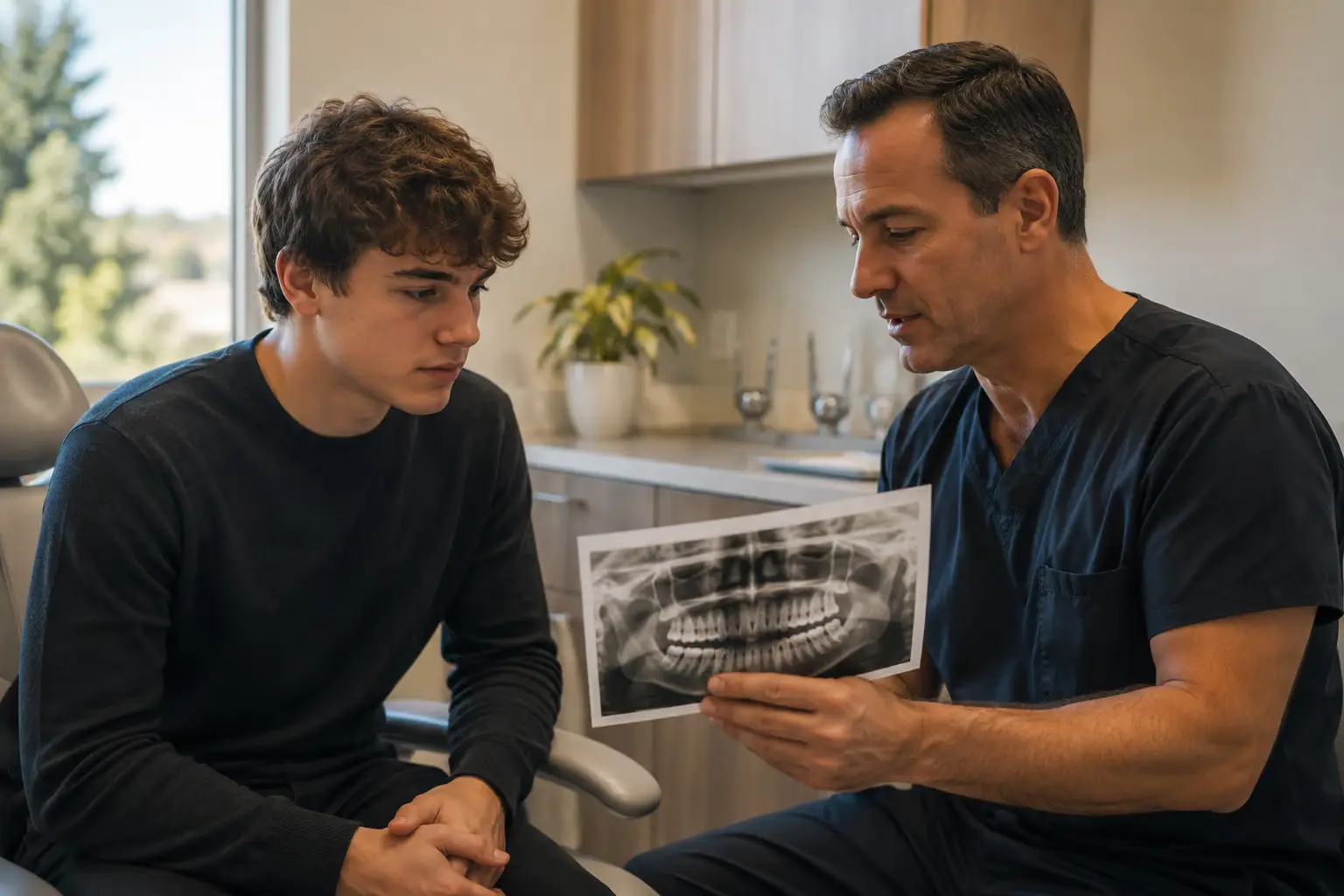
Soft-tissue closure is essentially complete; underlying bone remodels quietly over the next few months. A follow-up at 1–2 weeks confirms healing. Most patients need no further intervention.
A short visit, no sedation, bite and fit are confirmed before the final is made.
For parents
What parents of teenagers should know.
The decision your family is usually making isn’t whether removal is necessary, it’s about timing, anesthesia, recovery logistics, and cost. For impacted teeth, referral to an oral surgeon is the standard: impaction involves surgical bone removal, nerve management, and anesthesia within OMS training.
Late spring or early summer is the most popular scheduling window
IV sedation requires an adult to drive your child home and stay 24 hours
Plan 4–5 days off school, plus a buffer for sports restrictions
Most dental insurance covers a meaningful portion of impacted removal
Practical parent checklist
01
Get the panoramic imaging at your child’s next routine dental visit, it determines whether a referral is needed.
02
Schedule the consultation early, spring-break and summer windows fill months in advance.
03
Arrange transportation, a responsible adult must drive and stay for the first 24 hours. Non-negotiable.
04
Pre-fill prescriptions the day before so they’re ready when you get home.
05
Stock soft foods in advance, yogurt, applesauce, eggs, soup, smoothies (no straws).
06
Watch for warning signs after day 3–4: increasing pain, fever, worsening swelling, or bad-tasting drainage.
Risks & complications
What can go wrong, and what we do about it.
Wisdom-teeth removal is one of the safest surgical procedures performed in the U.S. Complications are uncommon when done by an oral surgeon at the recommended age. Here is the honest profile.
Strict post-op adherence (no smoking or straws, gentle hygiene). Resolves in 5–7 days with irrigation and a medicated dressing.
3D CBCT when nerve proximity is suspected; coronectomy considered when risk is elevated. Most altered sensation resolves over weeks to months.
Technique that avoids excessive lingual flap retraction and careful posterior soft-tissue handling. Most injuries are temporary.
Pre-surgical 3D imaging when sinus proximity is suspected; post-op restrictions. Most close spontaneously within 1–2 weeks.
Sterile technique, prophylactic antibiotics when indicated, and patient education on warning signs with timely follow-up.
Careful imaging review of the second-molar relationship; sectioning of complex impactions to avoid force on the adjacent tooth.
All risks are reviewed in detail at consultation and again as part of informed consent before surgery. Figures reflect general published rates in the third-molar literature; individual risk varies by age, anatomy, medical history, and behavior.
Patient Reviews
Trusted By Patients. Rated 5.0 On Google.
“I really appreciated how attentive and detailed Dr. Volland and his team were when answering questions and sharing what the experience would be like when getting my wisdom teeth removed. I felt very at ease during and after the procedure because of their reassurance despite being uneasy initially.”
“Dr. Volland is amazing! Had a great journey getting my wisdom teeth removed and a bone graft done. All the staff are super nice and make you feel at home. Recovery was quick, and I could tell I was in expert hands.”
“I was very nervous going into the procedure. Dr. Volland was absolutely amazing. He was kind, reassuring, and took the time to make me feel comfortable every step of the way. The procedure was quick, smooth, and much easier than I expected.”
“I cannot say enough about Dr. Volland. He is so thorough and caring. He truly listens to patients, making every visit feel special. Got my all-on-x treatment done, and the results are amazing!”
“The calm atmosphere and confidence of the dr and assistant was reassuring. The extraction was painless and they were attentive to me throughout the procedure. They made the entire experience as comfortable as possible.”
“Dr. Volland was super professional during my consult. Definitely recommend him for anyone in the Sumner area looking for dental implants. Talked through everything in detail. He truly knows his stuff!”
“Dr. Volland did an amazing job! The procedure was quick, completely painless, and I was in and out in no time. My recovery was also very fast and pain-free. Highly recommend!”
“Dr. Volland is as professional as he is kind. His extractions are quick and easy, implants are successful and look great, and IV sedation makes the whole process go off without a hitch.”
“Dr. Volland was so gentle and made sure I was comfortable during my implant surgery. He's the only Dr I'll trust with my oral surgery needs!”
“I went in for a dental implant under sedation and it was absolutely painless! It was so easy and smooth. I can't thank him enough!”
“Our family had an excellent experience with Dr. Volland and his team. Dr. Volland personally took a call from me when we got home and answered my questions. His commitment to patient care is outstanding.”
Opening January 2027
Wisdom teeth removal at Elite requires a referral.
If a recent panoramic image shows wisdom teeth that may need attention, ask your general dentist for a referral to Elite Oral Surgery. No general dentist yet? Our office can recommend one in the Bonney Lake area. The referral process is typically completed in 1–2 business days.
Common Questions
Questions worth asking.
When impacted wisdom teeth are present, removing all four in a single session is often recommended. Wisdom teeth frequently develop in similar positions on both sides, so one impacted tooth may be accompanied by others. This also means one anesthesia experience and one recovery period instead of two. Exceptions exist. Fully erupted, well-positioned teeth with good hygienic access can sometimes be retained. The right approach is determined during consultation.
General dentists are trained to remove erupted, straightforward teeth. Impacted teeth may require surgical bone removal, tooth sectioning, careful nerve management, and anesthesia. These are areas routinely handled within oral surgery. Referring these cases to an oral surgeon is common practice and reflects the complexity of the procedure, not a deficiency in your dentist.
Cost varies based on the number of teeth, type of impaction, anesthesia, and insurance coverage. Many dental plans cover a meaningful portion of treatment, often 50% to 80% of allowable charges. Out-of-pocket costs typically range from $200 to $600 per tooth for simple extractions and $400 to $1,200 per tooth for impacted teeth, with anesthesia billed separately. We verify your benefits and provide a written estimate before treatment.
It’s possible for fully erupted teeth in low-anxiety patients, but uncommon for impacted cases. Most patients find IV sedation substantially more comfortable, and the workflow is more efficient with a sedated patient. Local anesthesia alone is a reasonable option for the right case, and can be discussed at consultation.
Most patients return to school or non-strenuous work within 3–5 days. The first 48–72 hours are the most uncomfortable, with swelling peaking around days 2–3. For physically demanding work or contact sports, a 7–14 day restriction is more appropriate.
Not having symptoms does not always mean wisdom teeth are problem-free. Impacted teeth can develop bacterial buildup, damage neighboring teeth, or form cysts without causing noticeable pain.³ For younger adults with impacted wisdom teeth, removal may be recommended before these problems develop and while surgical risks are generally lower.² Well-positioned teeth with enough room to erupt may instead be monitored over time.
No. IV sedation requires someone to drive you home and stay for the first 24 hours, a non-negotiable safety requirement. Reaction time and judgment remain impaired for hours, even when you feel normal. For local anesthesia alone, driving is permitted once the numbness resolves.
A typical consultation takes 45 to 60 minutes and includes a review of your panoramic imaging, clinical exam, medical history, treatment options, and a written cost estimate. In most cases, surgery can be scheduled during the consultation. More complex cases may require additional imaging first.
Opening January 2027
Schedule Your Consultation.
Leave your details and we'll reach out as soon as consultations are available. No obligation, no marketing. Just a note when the door opens.
- Complimentary full-arch consultations
- No referral required for implant cases
- Dr. Volland follows up personally
9907 205th Ave E · Bonney Lake, WA 98391
(206) 738-2503