
General patient education, not a diagnosis or individualized treatment plan. Your treating clinician’s instructions take priority. Elite Oral Surgery’s Bonney Lake practice opens January 2027.
Best oral surgeon means different things to different patients. The right surgeon for a complex full-arch case is not necessarily the right fit for routine wisdom teeth. Rather than a self-promotional answer, this is an evaluation framework you can apply to any practice you are considering, including this one.
What to verify
- Hospital-based surgical residency 4 to 6 years
- Training pathway Verifiable on request
- Standard of care for implant planning CBCT
- Sedation credential in Washington GA Permit
Every item in this framework can be checked before you commit to treatment. Anything that cannot be checked, including superlative claims, is not evidence.
The short answer
- Single implant, post and abutment and crown $3K to $6K
- Multiple teeth, two teeth through most of an arch $6K to $30K
- Full arch at Elite, all-inclusive per arch $15,000
- Full arch elsewhere, chains and multi-provider practices $20K to $50K
Ranges reflect Washington State pricing across independent surgeons, multi-provider practices, and chain centers. Your own figure depends on anatomy and case complexity, which is what the consultation establishes in writing.
Why best is always contextual
No single oral surgeon is best across every clinical situation, and a practice claiming otherwise is telling you about its marketing rather than its surgery.
The best surgeon for full-arch dental implants is the one with substantial full-arch volume and demonstrated outcomes. The best surgeon for impacted wisdom teeth is one with strong third molar experience and good patient management. The best surgeon for jaw surgery is one with orthognathic training. Match the surgeon’s strengths to your case.
Claims like best oral surgeon in a given city signal nothing about clinical fit. Better questions: what procedures does this practice perform most often, what was the surgeon’s training pathway, how long was the hospital-based residency, and does the practice scope match my case.
Worth Knowing
Washington State Dental Quality Assurance Commission rules limit how dental practices may use superlative claims. Assertions of best clinical quality require objective verification, and most cannot be substantiated. Practices using that language casually are worth evaluating carefully.
Six evaluation criteria
Apply these to every practice on your list. All six are answerable before treatment, and most are answerable before the consultation.
- Surgical residency. Oral and maxillofacial surgery requires an accredited four to six year hospital-based residency — the longest training pathway in dentistry. Not every clinician placing implants has completed one. Ask where your surgeon trained rather than taking a website’s word.
- Training pathway and clinical exposure. Residency programs differ. Naval and military programs are typically high-volume surgical environments with a diverse case mix and substantial trauma exposure. University programs bring research and academic strengths. Hospital-based programs bring broad medical exposure. Ask where your surgeon trained.
- Practice scope match. Some practices concentrate on full-arch implants, jaw surgery or oral pathology, others carry broad general scope. For a full arch you want substantial volume, not occasional cases. For complex extractions you want strong general scope.
- Technology and surgical environment. CBCT is the standard of care for implant planning, and a practice without in-house CBCT is operating below it. IV sedation under a Washington General Anesthesia Permit is meaningfully different from oral sedation. Operatory setup, sterile processing and instrumentation all affect outcomes. Ask to see the practice if you have specific concerns.
- Communication with referring dentists. Your general dentist usually continues restorative care after the surgery. Whether the practice shares imaging, operative reports and post-operative recommendations clearly is often more revealing than any marketing, and your own dentist can tell you from experience.
- Continuity and follow-up. Single-doctor practices give continuity, since the surgeon you meet performs the surgery and follows recovery. Multi-doctor practices distribute care, and chains may rotate providers by schedule. Neither is universally better, but continuity matters for complex cases.
Red flags at any practice
Six patterns should raise concern regardless of how well a practice presents otherwise.
Heavy reliance on before-and-after marketing
Photographs can be selected, edited, or sourced from stock. Reputable practices may share outcomes with patient consent, but heavy emphasis on dramatic transformation is a sales tactic rather than clinical evidence.
Pressure to commit at consultation
Today-only pricing, urgency, and commission-incentivised treatment coordinators. Major procedures warrant time to consider, and a reputable practice gives you a written quote that stays valid for a reasonable period.
Vague answers to specific clinical questions
If a surgeon cannot or will not name the implant brand, the restoration material, the surgical technique, or what happens with a complication, that is the answer. Patients are entitled to clear answers.
Quote-only pricing without itemization
Pricing discussed after consultation with no written itemized estimate afterwards leaves room for the figure to move. The cost of a complex procedure belongs in writing before it is scheduled.
Inconsistent recommendations across the team
If the surgeon recommends one approach, the treatment coordinator another, and the financial team pushes a third, the practice has an internal alignment problem that becomes your confusion.
Credentials that cannot be verified
Legitimate credentials are verifiable through state dental board records. Unwillingness to provide verification should be weighed carefully.
Substance is checkable. Superlatives are not.
How Elite measures against the framework
For patients evaluating this practice with the framework above, here are the answers, in the same order.
Point by point
- Specialty training – Oral & Maxillofacial Surgery
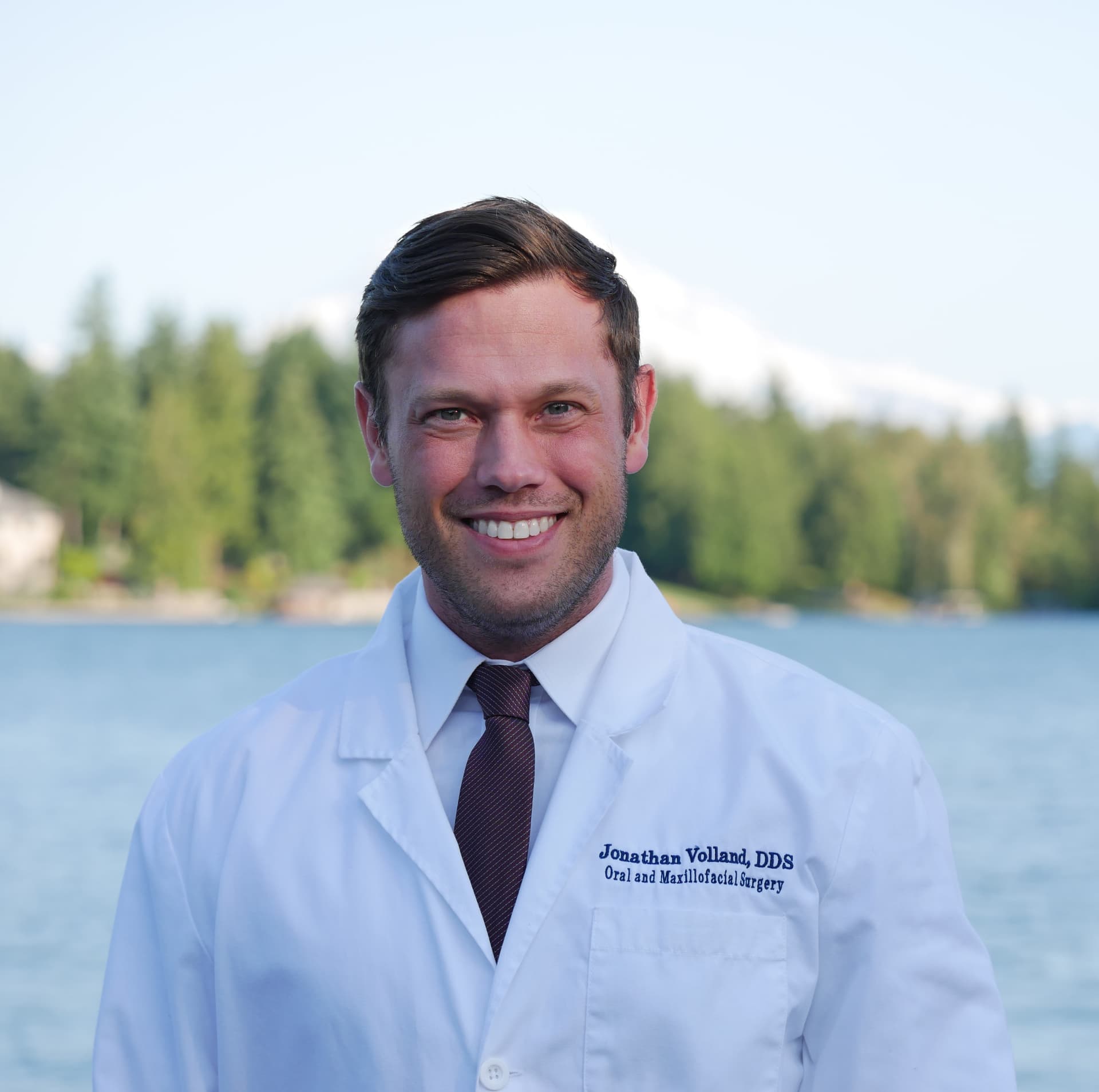
Dr. Jonathan Volland, four-year OMS residency at Naval Medical Center Portsmouth.
- Training pathway – Navy, 8 years
University of the Pacific Dugoni School of Dentistry, accelerated three-year DDS. Four-year oral and maxillofacial residency at Naval Medical Center Portsmouth. Eight years Navy active duty including a USS Nimitz deployment and concurrent attending positions at Madigan Army Medical Center, Naval Hospital Bremerton and NAS Oak Harbor. 3. Practice scope – Full arch primary
Full general oral surgery scope including wisdom teeth, surgical extractions, single implants, bone grafting, sinus lifts and IV sedation. Zygomatic protocols available for severe atrophy cases. 4. Technology – Planmeca Viso G7
CBCT for 3D implant planning, Bien-Air surgical handpieces, Washington General Anesthesia Permit for in-house IV sedation, zirconia from established U.S. dental labs, implants from major manufacturers. 5. Communication with referring dentists – Protocol published
Referral procedures and communication protocols are on the for dentists page. We do not market to your patients after their surgical case is complete. 6. Continuity – Single doctor
Every patient meets Dr. Volland at consultation. Dr. Volland performs every procedure and handles all follow-up care.
In plain language
Whether this practice is right for your case is a decision to make at consultation, with 3D imaging and a written treatment plan informing it. The framework above applies to every practice you evaluate, including the alternatives to this one.
Common questions
How do I verify a surgeon’s training myself?
Washington licence status and any disciplinary history are public through the state Department of Health, and any practice should be able to tell you exactly where its surgeon completed residency. Both checks take a few minutes and are worth doing for any surgeon you are considering.
Does it matter where a surgeon completed residency?
It shapes the case mix they trained on rather than ranking them. Military programs are typically high-volume with substantial trauma exposure. University programs bring research and academic depth. Hospital-based programs bring broad medical exposure. What matters is whether that training lines up with the procedure you need.
Should I get a second opinion before implant surgery?
For a full-arch case, generally yes, particularly when quotes or recommendations differ substantially. A second opinion costs a consultation and can change the treatment plan or the price by a great deal. A practice confident in its recommendation will not discourage you from seeking one.
Are online reviews useful for choosing an oral surgeon?
They are useful for the parts patients can judge: communication, waiting times, how the practice handled a problem. They are weak evidence on surgical quality, which patients are not positioned to evaluate, and small practices carry small sample sizes. Weight them alongside credentials and your own dentist’s experience rather than instead of them.
What if a practice will not give me a written itemized quote?
Treat that as a finding rather than an inconvenience. Written itemized pricing is how you compare practices and how you avoid charges appearing mid-treatment. For a procedure at this scale, the quote should name the implant brand, the final restoration material, what happens if grafting is required, and what happens if there is a complication.
Is a newly opened practice a risk?
The practice is new, the surgeon is not. What matters is the training, the certification and the case volume behind the surgeon, all of which are verifiable independently of how long the doors have been open. Ask the same six questions you would ask anywhere.