
General patient education, not a diagnosis or individualized treatment plan. Your treating clinician’s instructions take priority. Elite Oral Surgery’s Bonney Lake practice opens January 2027.
Implant cost varies more than almost any other procedure in dentistry: the same materials and the same techniques, priced very differently depending on where you go. Here is the breakdown for single implants, multiple implants, and full-arch cases, plus how to read a quote from any provider.
The short answer
- Single implant, post and abutment and crown $3K to $6K
- Multiple teeth, two teeth through most of an arch $6K to $30K
- Full arch at Elite, all-inclusive per arch $15,000
- Full arch elsewhere, chains and multi-provider practices $20K to $50K
Ranges reflect Washington State pricing across independent surgeons, multi-provider practices, and chain centers. Your own figure depends on anatomy and case complexity, which is what the consultation establishes in writing.
What dental implants cost, by category
How many teeth you are replacing changes the arithmetic more than any other factor, so it is worth finding your category before reading anything else about price.
The same titanium, the same laboratory zirconia, and the same surgical technique can be priced two or three times apart depending on where you have the work done. Before getting to why that happens, here is what each category of treatment actually costs in Washington State.
A single tooth
$3,000 to $6,000
A single implant is three components: a titanium post placed in the jaw, an abutment that connects to it, and a crown on top. Where you land inside that range depends on the position of the tooth in your mouth, the complexity of the site, the materials chosen for the crown, and whether bone grafting is needed before placement.
What sits inside the number
- Titanium implant — $1,800 to $3,000
- Abutment — $500 to $800
- Crown — $1,200 to $2,500
- Imaging and placement — Usually bundled
More detail on the surgical sequence and healing timeline is on the single dental implants page.
Watch for
Some practices advertise only the surgical placement portion of a single implant, around $1,800 to $2,500, which excludes the abutment and the crown. By the end of treatment you have paid $3,000 to $5,000 at minimum. Ask for a written quote covering placement, abutment, and crown together, and ask whether grafting is likely in your case.
Several teeth
$6,000 to $30,000
With more than one tooth missing there are two routes: an implant for each missing tooth, or an implant-supported bridge that carries several teeth on fewer implants. Which one is right is a clinical question about bone volume and bite forces, not a budget question, though the cost difference between them is real.
- Two teeth, individual implants — $6,000 to $10,000
- Two teeth, implant bridge — $5,000 to $8,000
- Three to four teeth — $9,000 to $20,000
- Five or more teeth — Full-arch territory
Once you are replacing five or more teeth in the same jaw, the economics usually favour treating the arch as a whole rather than tooth by tooth, and the conversation shifts to the category below.
A full arch
$15,000 per arch at Elite
A full arch replaces every tooth in one jaw with a fixed bridge supported by four to six implants. It is the largest category of implant treatment and the one where the difference between providers is most dramatic: the same arch is quoted anywhere from $15,000 to $50,000 in this region. At Elite Oral Surgery the price is $15,000 per arch, all-inclusive, and the section below lists exactly what that covers. The clinical detail lives on the full-arch dental implants page.
What $15,000 per arch actually includes
Most full-arch programs bill surgery, sedation, provisional teeth, and the final zirconia bridge separately, then add upcharges for materials. The figure you are first quoted is rarely the figure you pay. Here it is one number, and this is the complete list of what that number buys.
- Surgical placement of four to six implants per arch
- 3D Cone Beam CT imaging and surgical planning
- In-house IV sedation, administered by the oral surgeon
- Same-day printed PMMA provisional bridge
- Week-eight printed prototype try-in
- Final zirconia bridge with titanium bar
- All scheduled follow-up visits for twelve months
- Post-operative care kit and medications
The $15,000-per-arch offer includes extractions, IV sedation, bone grafting if needed, sinus lifts and final zirconia teeth. Severe bone loss may call for a different implant approach; discuss specialized options and the written plan at consultation.
In plain language
What matters is when you find out. Candidacy and any additional procedures are established from your 3D imaging at the consultation, so the complete figure is on paper before a surgical date is set. Nothing in that category is discovered mid-treatment and billed afterward.
You are told at consultation, not in the chair.
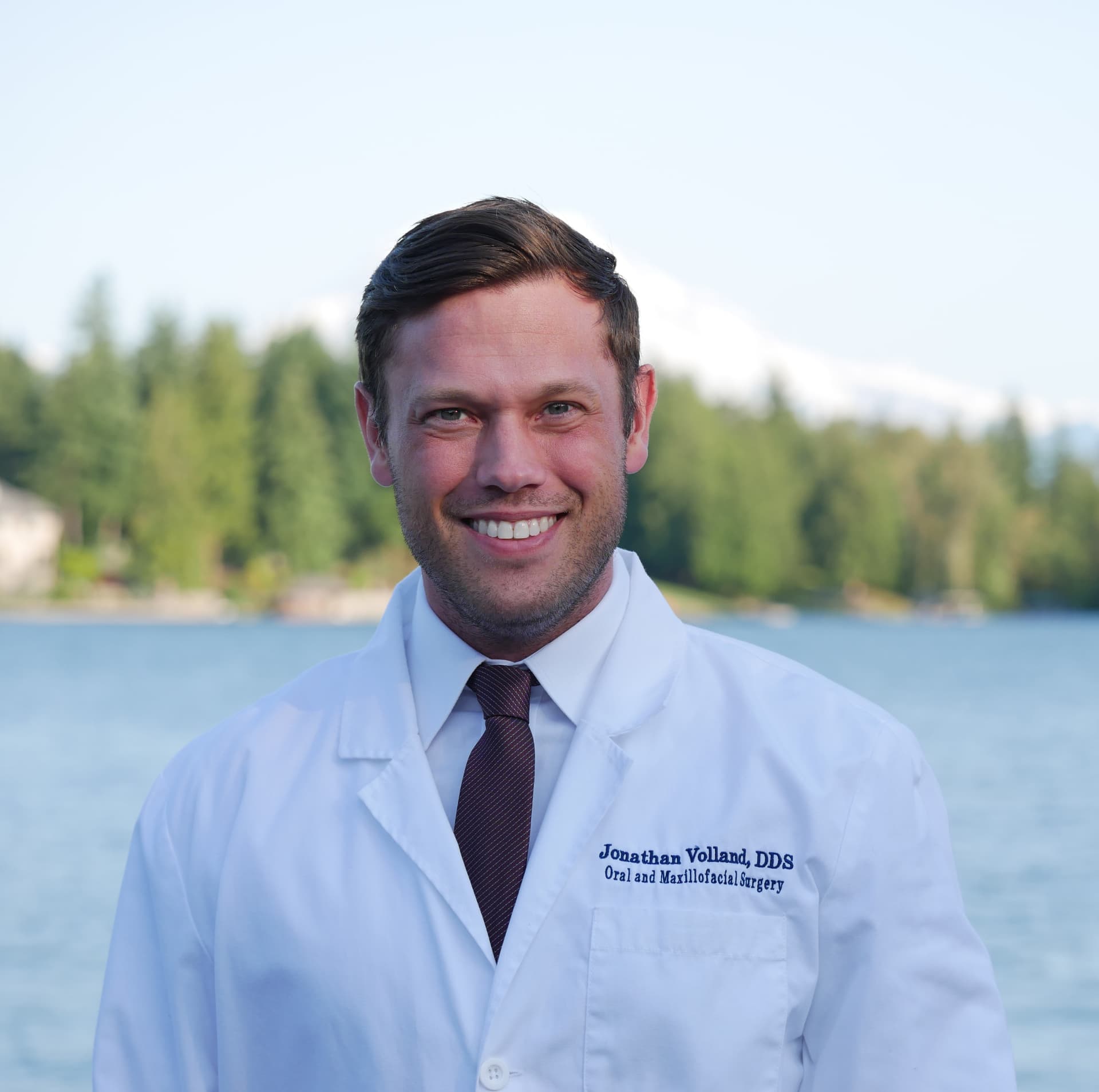
— Dr. Jonathan Volland
Why the same full arch is priced three ways
Full-arch is where the market disagrees most, and the disagreement is large enough to be confusing. Three provider types cover almost every quote you will receive in the Puget Sound region.
- Elite Oral Surgery, independent single-doctor practice — $15,000
- Chain implant centers, ClearChoice, Nuvia and similar — $20K to $36K
- Oral surgeon plus prosthodontist, regional multi-provider practices — $25K to $50K
Chain centers often advertise at the lower end of their range, but those figures usually reflect a long-term PMMA provisional rather than a final zirconia bridge. Cases that include zirconia commonly run $25,000 to $35,000.
Multi-provider practices split the work: surgical placement, prosthetic design, and lab work are billed by separate providers, each carrying its own overhead and margin. The clinical quality can be excellent. The structure simply costs more to run.
City-level figures
What actually drives the difference
This is the single most useful thing to understand about implant pricing: the difference between providers usually reflects business structure rather than clinical quality. Four inputs are effectively identical everywhere. Titanium implants from the major manufacturers, zirconia from established U.S. dental labs, surgical technique drawn from the same peer-reviewed literature, and IV sedation under a Washington General Anesthesia Permit.
What differs is everything around the surgery.
Geographic overhead
Practices in Seattle and Bellevue commercial real estate carry meaningfully higher fixed costs than an independent practice in a market like Bonney Lake. Part of an implant price is rent.
Practice model
A single-doctor practice supports one provider’s overhead and margin. Multi-provider practices distribute revenue across surgeons, prosthodontists, hygienists, and management staff. Chains add corporate overhead and national marketing budgets on top of both.
Operational focus
A practice where full-arch treatment is the primary specialty operates differently from a general oral surgery practice taking occasional full-arch cases. Once volume is meaningful, specialization lowers the cost of each case.
Ownership structure
DSO-owned practices and chain centers pay management fees and corporate parent overhead that an independent owner-operator practice does not. That structure flows straight through to the price you are quoted.
How to use this
When one practice quotes $35,000 per arch and another quotes $15,000, the useful question is not what is wrong with the cheaper one. It is: what is the structural reason for the difference, and does that reason imply anything clinical? Often the reasons are real but do not translate into clinical differences.
Titanium integrates with bone the same way regardless of who placed it.
How patients actually pay
Very few patients pay the headline number in cash. Four mechanisms move it, and they stack.
Dental insurance
usually under 10% of a full-arch case
Most plans cap annual maximums between $1,000 and $2,500 and either limit or exclude implants outright. A single implant might see $500 to $2,000 covered. A full-arch case is typically offset by less than a tenth of the total. We verify your specific coverage and put patient responsibility in writing before treatment begins. See insurance for the detail.
Medical insurance
case by case
Medical plans occasionally cover meaningful portions of treatment when tooth loss follows documented trauma, oncologic treatment, a congenital condition, or specific systemic disease. It requires medical documentation and usually pre-authorization. For patients who qualify it changes the out-of-pocket picture substantially, so it is worth raising at consultation.
Financing
$250 to $450 per month
Cherry, Proceed Finance, Sunbit, LendingClub, and CareCredit offer terms ranging from 0% APR introductory periods through fixed rates up to 60 months. For a $15,000 arch, monthly payments typically land between $250 and $450 over a 36 to 60 month term. Terms and approval detail are on the financing page.
HSA and FSA funds
an effective 20 to 35% discount
Health Savings and Flexible Spending funds are eligible for all implant treatment, which reduces the real cost by your marginal tax rate. A $15,000 arch paid with HSA funds has an effective cost closer to $9,750 to $12,000 depending on your bracket.
Put together
Financing over a long term, HSA tax savings, and whatever insurance contributes bring the procedure within reach of a much broader range of patients than the headline number suggests.
Common questions
Why is the cost range so wide?
Three things widen it: the clinical situation, ranging from one tooth to a whole arch; the business model, whether independent, multi-provider, or chain; and what the quote actually contains, surgery alone versus all-inclusive with the final restoration. The same procedure, performed with the same implants and materials, can be priced very differently, and the difference is mostly overhead and structure rather than clinical quality.
Is the cheapest dental implant always the best value?
No, and neither is the most expensive. The better question is what is included at this price, and what is the structural reason for the difference between this quote and the others. Sometimes the reasons are clinical, such as surgeon experience or materials. Often they are business-model reasons that do not affect outcomes. Get itemized written quotes and ask specifically about implant brand, restoration material, and what happens if a complication arises.
What is the catch with $15,000 full-arch implants at Elite?
The honest answer is that the price reflects an independent owner-operator practice in a Pierce County commercial market with full-arch as its primary specialty, not reduced clinical quality. Same titanium implants from major manufacturers, same zirconia from established U.S. labs, same surgical techniques, same Washington General Anesthesia Permit-authorized IV sedation. The structural difference is practice model, geography, ownership, and operational focus. The clinical work is the same.
How do I compare quotes from different practices?
Get an itemized written quote from each. Verify it includes surgical placement, IV sedation if applicable, all imaging, the abutment, the final restoration rather than just the provisional, and follow-up care. Ask about implant brand and restoration material by name. Ask whether bone grafting is included or extra if it turns out to be needed. Ask when the final restoration is delivered, since a same-day provisional is not a final bridge. The lowest headline number often expands considerably once these are itemized.
Can I afford dental implants?
For most patients, yes, particularly with financing. A $15,000 arch financed over 60 months runs roughly $250 to $400 per month depending on credit profile and lending partner. Add HSA or FSA tax savings, an effective 20 to 35% discount, plus whatever insurance contributes, and the procedure reaches a much broader range of patients than the headline number suggests. For patients facing hard cost barriers, snap-in dentures can be a more affordable starting point for the lower jaw specifically.
Does the price change if I need bone grafting?
Bone grafting if needed for your full-arch treatment and sinus lifts are included in the $15,000-per-arch offer. Imaging and an examination establish your proposed care; discuss specialized options in the written plan before deciding.